Body composition & growth hormone
Tesamorelin
People use tesamorelin to shrink deep belly fat by boosting their own growth hormone; it is an FDA-approved drug for that use in adults with HIV, and use by anyone else is off-label.
One-time step
Research use only
Scroll through the five parts below. The tick box and button are at the end. Your Tesamorelin dose then opens right here. Once only, here and on the Lifebuff site.
Quick guide
Your dose
1 mg
10units
Draw to the 10 line on a 0.5 mL U-100 insulin syringe.
Range 1–2 mg · 10–20 units
Mixed for you
Your 20 mg vial comes mixed with 2 mL bacteriostatic water. Each unit is 100 mcg.
The store dose of 1 mg a day is a starting point. It is the community's beginner dose and the dose used in a 20-week trial in older adults. The main FDA trials used 2 mg a day, so you can step up toward it if you need more. Many users start at 1 mg (10 units) to check how they feel, then some move to 2 mg (20 units).
-
How often
Once a day
Every day
-
When
Morning (store protocol).
-
Where
Belly
Under the skin
-
Storage
In the fridge (2-8 °C)
-
Cycle
On: 12-26 weeks
Break: Stop, or drop to 5 days a week
Full course: 5–10 vials
- Status
- FDA-approved only as the prescription drugs EGRIFTA SV and EGRIFTA WR, to reduce excess belly fat in adults with HIV-related fat changes (lipodystrophy). This research vial is not EGRIFTA. Banned at all times in tested sports (WADA).1213
- Evidence
- Large placebo-controlled human trials, mostly in people with HIV; smaller trials in other adults
Week by weekWhat to expect
- Week 1-2: Growth hormone rises; have your blood sugar checked
- Week 2-4: Users report subtle sleep, energy gains; some get aches
- Week 4-8: Users say belly fat starts to drop; weight barely changes
- Week 8-12: Trials, week 12: trunk fat down about 5% on 1 mg, 9% on 2 mg
- Side effects: Mostly redness, aches; get help for allergy signs or high blood sugar
More on each stage
- Week 1-2
- Your growth hormone and IGF-1 rise. In healthy men on 2 mg a day, both were clearly higher after 2 weeks, and fasting blood sugar did not change. Blood sugar can creep up over months, so get it checked. Community users say better sleep is often the first thing they notice.
- Week 2-4
- Community users report subtle sleep and energy gains. Early joint aches, mild swelling in hands or feet, or tingling can show up; in trials these usually faded or went away after stopping.
- Week 4-8
- Community users say they start to notice less deep belly fat at about 6-8 weeks. Your scale weight will likely not change much: in trials tesamorelin did not change body weight.
- Week 8-12
- In a 12-week trial, 2 mg a day cut trunk fat by about 9%, while 1 mg cut it by about 5%. In the 26-week FDA trials at 2 mg, deep belly fat dropped about 14-18% and lean mass rose about 1.2-1.3 kg. Community users report the biggest changes at 12-16 weeks.
- Side effects
- Most often redness or itching where you inject, joint or muscle aches, swelling in hands or feet, and tingling or numbness. Stop and get help for any sign of an allergic reaction or high blood sugar.
Based on what people report in the community sources below. Results vary, and many responses are anecdotal.
Why people use itBenefits and research
-
Less deep belly fat
FDA-labeledIn two FDA trials of adults with HIV, 2 mg a day for 26 weeks cut deep (visceral) belly fat by about 14-18%, compared with a 2% change on placebo. Fat under the skin and in the arms and legs did not change. The fat came back after stopping.134
-
Keeps or adds lean mass
FDA-labeledIn the same FDA trials, lean body mass rose about 1.2-1.3 kg on tesamorelin, while it stayed flat on placebo. Total body weight did not change.1
-
Less belly fat in people without HIV
Clinical trialIn 60 adults with belly obesity and low growth hormone, 2 mg a day for 12 months shrank deep belly fat and lowered triglycerides and an inflammation marker (CRP), without raising blood sugar.8
-
Less liver fat
Clinical trialIn adults with HIV and fatty liver, 2 mg a day for 12 months cut liver fat by 37% compared with placebo, and 35% got their liver fat back into the normal range (vs 4% on placebo).76
-
Better blood fats
Clinical trialIn the first large FDA trial, triglycerides fell by 50 mg/dL on 2 mg a day, while they rose by 9 mg/dL on placebo. The cholesterol-to-HDL ratio also improved.3
-
Sharper thinking in older adults
Clinical trialIn 152 adults aged 55-87, 1 mg a day at bedtime for 20 weeks improved planning and focus skills (executive function), both in healthy people and in people with mild memory problems. It also cut body fat by 7.4%.9
-
Sleep and energy
Community reportCommunity users often report better sleep within 1-2 weeks and subtle energy gains in the first month. These are self-reports.14
What it has been studied for
- Reducing excess belly fat in adults with HIV-related lipodystrophy (the approved use; the label says it is not a weight-loss drug)12FDA-labeled
- Deep belly fat and blood fats in adults with HIV (two 26-week trials of about 400 people each, with 26-week extensions)34Clinical trial
- Fatty liver in adults with HIV (liver fat fell in 6-month and 12-month trials)67Clinical trial
- Belly fat, triglycerides, and artery-wall thickness in adults with belly obesity and low growth hormone, without HIV (12 months)8Clinical trial
- Thinking skills in healthy older adults and adults with mild memory problems (20 weeks)9Clinical trial
- Growth-hormone pulses and insulin sensitivity in healthy men (2 weeks; insulin sensitivity did not change)10Human study
In the bodyHow it works
Tesamorelin is a lab-made copy of a brain signal (GHRH) that tells the pituitary, a gland in your head, to release growth hormone. It is your body's own 44-block version of that signal, with a small fatty chain added at one end. It makes the pituitary release more of your own growth hormone, in the same natural bursts as usual. Growth hormone then tells the liver to make a second growth signal (IGF-1) and helps break down deep belly fat. It does not change the pituitary's other signals, such as those for thyroid, stress, or sex hormones.
It flips the pituitary's growth-hormone switch, so it releases more of your own growth hormone in normal bursts. Other pituitary hormones did not change in trials (FDA label).
Growth hormone makes the liver release more of a growth signal (IGF-1), up about 107-108 ng/mL after 26 weeks on 2 mg a day in two FDA trials, but not on a dummy shot. Liver fat also dropped in people with fatty liver (clinical trials).
It shrinks deep belly fat around the organs by about 14-18% in 26 weeks. Fat just under the skin stays the same (FDA label).
Lean body mass (muscle and other non-fat tissue) rose about 1.2-1.3 kg in 26 weeks (FDA label).
In a 12-month trial in adults with obesity around the belly, it lowered triglycerides (a blood fat) and slightly thinned the wall of the neck artery (clinical trial).
In older adults, it improved planning and focus skills over 20 weeks (clinical trial).
Extra growth hormone can make the body hold on to fluid. This can cause joint aches, swelling, and carpal tunnel symptoms (FDA label).
Peak, half-life, clearancePharmacokinetics
- Peak
- About 9 minutes after an under-the-skin shot (median 0.15 hours in healthy adults and people with HIV, FDA label). Less than 4% of a shot reaches the blood. The effect lasts much longer than the drug: IGF-1 was clearly higher after 2 weeks of daily shots.
- Half-life
- 8 to 11 minutes in healthy adults, measured for the two approved brands (8 minutes for EGRIFTA SV, 11 minutes for EGRIFTA WR). It has not been measured for research vials.
- Cleared
- Not measured directly. Using an 11-minute half-life, about 97% of a dose would be gone in about an hour (five half-lives; an estimate). Its effects fade more slowly: in healthy men, growth hormone and IGF-1 were back to normal 2 weeks after the last dose.
Half-life is how long it takes the body to remove half of a dose.1210
Research and communityDosing guidance
Typical
1 mg
10 units
Higher
2 mg
20 units
Once a day. Morning (store protocol). Bedtime also works; pick one time and keep to it. Every day. Units are for a 20 mg vial mixed with 2 mL water (10 mg per mL).
What the community uses
Community reportLower end · tolerance-test half dose
1 mg once daily
A half-dose protocol new users run to assess tolerance before stepping up to the full 2 mg.14
Most common · mirrors FDA-labeled Egrifta dose
2 mg once daily
The community mirrors the FDA-labeled Egrifta dose (2 mg) for off-label visceral-fat reduction — injected abdominally before bed, knowing fat rebounds after stopping.14
Higher end · reduced-frequency maintenance
1-2 mg, 5 days per week
A reduced-frequency maintenance protocol some use long-term, accepting slower progress to lower cost and injection frequency.14
Standard fat-loss protocol
2 mg once a day, injected into the belly before bed, for 12-26 weeks. This is the most popular community dose and mirrors the original FDA dose.14
Beginner protocol
1 mg once a day for 12-16 weeks to check tolerance before possibly moving to 2 mg. The store protocol (1 mg every morning) matches this dose.14
Maintenance protocol
1-2 mg, 5 days a week (for example Monday to Friday), ongoing with periodic breaks.14
With ipamorelin
1-2 mg tesamorelin plus 200 mcg ipamorelin, once a day before bed, for 12-16 weeks.14
Research protocols
FDA trials that led to approval (adults with HIV and excess belly fat)
2 mg under the skin of the belly once a day for 26 weeks, then either continued for another 26 weeks or switched to placebo.134
Current approved brands (different formulas that absorb better)
EGRIFTA SV: 1.4 mg once a day. EGRIFTA WR: 1.28 mg once a day. Both give about the same blood levels as 2 mg of the original formula, and both are injected into the belly.21
Dose-finding trial (61 adults with HIV)
1 mg or 2 mg once a day for 12 weeks. IGF-1 rose 48% at 1 mg and 65% at 2 mg.5
Thinking-skills trial (older adults)
1 mg under the skin once a day, 30 minutes before bed, for 20 weeks. This matches the store dose.9
Liver-fat trials (adults with HIV)
2 mg once a day for 6 months, and in a second trial for 12 months followed by 6 months on the drug for everyone.67
Belly-obesity trial (adults without HIV)
2 mg once a day for 12 months.8
Healthy men, growth-hormone study
2 mg under the skin once a day in the morning for 2 weeks, then 2 weeks off. Growth hormone and IGF-1 returned to baseline during the 2 weeks off.10
Egrifta is FDA-approved only for HIV-associated lipodystrophy — community use for general visceral fat is off-label. Clinical data shows visceral fat rebounds after stopping, so community users expecting permanent results from a short cycle are disappointed.
Dosing guidance built from the cited research and community reports. It is not a prescription.
On and offCycling
- On
- 12-26 weeks
- Break
- Stop, or drop to 5 days a week
A full course at the store pace takes 5–10 vials. A mixed vial keeps for up to 90 days.
Why the break helps
A course runs 12-26 weeks of daily shots, the length community users most often run. Then you stop, or drop to 5 days a week to hold your results. In the FDA trials, belly fat came back when people stopped: those switched to placebo regained 16-22% of their deep belly fat within 6 months. Use the end of a course as a checkpoint: IGF-1 (a growth-hormone blood marker) ran above the normal range in about half of trial users by 26 weeks, the drug can raise blood sugar, and long-term heart safety is not known. The FDA label says to reconsider continuing if your belly fat has not gone down. Get IGF-1 and blood sugar (HbA1c) checked before you start and every few months.
What to watch forSide effects
Common
Redness, itching, pain, or a bruise where you injected (about 25% on tesamorelin vs 14% on placebo in the FDA trials)
What to do Rotate spots across your belly and use a fresh syringe every time. If redness spreads or gets hot and painful, treat it as an infection (see below).
Joint pain (13% vs 11% on placebo), muscle aches (6% vs 2%), or pain in the arms or legs (6% vs 5%). These come from fluid the body holds when growth hormone rises.
What to do In trials these usually faded or went away after stopping. If they do not settle, or you are on 2 mg, go back to 1 mg (10 units). If they get worse, stop and talk to a doctor.
Swelling in the hands, feet, or ankles (6% vs 2% on placebo)
What to do In trials this usually faded or went away after stopping. If it keeps growing or comes with shortness of breath, stop and see a doctor.
Tingling (5% vs 2%) or numbness (4% vs 2%), often in the hands
What to do Tell a doctor if it lasts, especially numbness or pain in the wrist and fingers, which can be carpal tunnel syndrome.
Rash or itching on the body (4% vs 2%), upset stomach, or vomiting (3% vs 0%)
What to do A rash can be an allergy. If it spreads or comes with any symptom in the serious list, stop and get help.
Stop and get help
Allergic reaction: rash over the body, hives, swelling of the face or throat, trouble breathing, fast heartbeat, or feeling faint. Allergic-type reactions happened in 4% of trial users.
What to do Stop tesamorelin and call 911 (or your local emergency number) right away.
High blood sugar: strong thirst, peeing a lot, or unusual tiredness. In the FDA trials, 5% on tesamorelin developed diabetes-range blood sugar (HbA1c 6.5% or higher) vs 1% on placebo.
What to do Stop tesamorelin and get your blood sugar and HbA1c checked by a doctor soon.
Carpal tunnel syndrome: numbness, tingling, or pain in the hand and wrist
What to do Stop tesamorelin and see a doctor. In trials, fluid-related problems went away after stopping.
Vision changes if you have diabetes. The FDA label warns that higher IGF-1 can start or worsen diabetic eye disease.
What to do Stop tesamorelin and see an eye doctor promptly.
Any sign that a past cancer is coming back, or a new lump. Growth hormone is a growth signal.
What to do Stop tesamorelin and see your doctor right away.
Infection at the injection site: redness that spreads, heat, pus, red streaks, or fever
What to do Stop injecting and see a doctor the same day.
Do not use if
- You are pregnant or trying to get pregnant: the FDA label forbids it, and it caused skull and brain defects in unborn rats.
- You are breastfeeding: there is no data on whether it passes into breast milk.
- You have active cancer, or a cancer that is not fully treated and stable.
- You have pituitary problems: a pituitary tumor or surgery, low pituitary function, head radiation, or a serious head injury.
- You have diabetes or prediabetes, unless your doctor agrees and checks your blood sugar and eyes.
- You are seriously ill, or have heart surgery, stomach surgery, or major trauma coming up. Raising growth hormone in critically ill people has been linked to more deaths.
- You are under 18: it can speed growth while growth plates are open.
- You compete in a drug-tested sport: WADA bans tesamorelin at all times, in and out of competition.
Sites and techniqueInjecting
Under the skin (subcutaneous)
- Belly, 2 inches from the navel
Inject into the belly only, as the FDA label directs. Use a different spot on the belly each day. Do not inject into the belly button, scars, or bruises.
Storage
- Keep it
- Keep the mixed vial in the fridge (2-8 °C), upright and away from light. Do not freeze it, and never leave it in a hot car.
- How long
- Use within 90 days of mixing. A mixed vial kept in the fridge holds its strength for 60-90 days, then slowly starts to lose potency. Wipe the rubber top with an alcohol swab before every draw.
Drawing your dose
Stop when the top edge of the black stopper reaches the 10 line.
Syringe: a 0.5 mL (50-unit) U-100 insulin syringe.
- With this mix, each 1 unit line on a U-100 insulin syringe holds 0.1 mg (100 mcg). Draw to 10 units for 1 mg or 20 units for 2 mg.
- Check the liquid before each dose. It should be clear and colorless. Do not use it if it looks cloudy, colored, or has specks.
- Wipe the top before every draw. Hold the syringe at eye level, flick out air bubbles, and push the plunger back to the exact line.
- Pinch a fold of belly skin, insert the needle at 45 to 90 degrees, push slowly, and wait a few seconds before pulling out.
- Use a new sterile syringe every time and never share one, even with a new needle.
Stacks and interactionsPairs well with
-
Ipamorelin triggers growth hormone through a different receptor (the ghrelin receptor) from tesamorelin (the GHRH receptor). In human studies, a GHRH signal plus a ghrelin-type peptide released more growth hormone together than either alone. Community users pair 1-2 mg tesamorelin with 200 mcg ipamorelin at bedtime, and both are in the store's Lean Machine stack. Together they raise IGF-1 and blood-sugar risk more, so get both checked.1114
-
They do different jobs. Retatrutide lowers appetite and body weight: up to 24% weight loss in 48 weeks in a trial. Tesamorelin does not change body weight but targets deep belly fat and kept lean mass up in trials. Both are in the store's Lean Machine stack. Tesamorelin can raise blood sugar, so check your blood sugar.121
Interactions
Steroid (glucocorticoid) replacement for low adrenal function, such as hydrocortisone, prednisone, or cortisone acetate
Raising growth hormone can lower how much active cortisol your body makes from these medicines, so you may need a higher dose, especially during illness or stress.
What to do Tell the doctor who manages your steroid before you start.
Diabetes medicines (insulin, metformin, GLP-1 drugs) and other medicines that lower blood sugar
Tesamorelin can raise blood sugar, so these medicines may need adjusting.
What to do Ask your doctor first and check your blood sugar more often, especially in the first weeks.
Medicines cleared by liver enzymes (CYP450), such as testosterone, estrogen and birth-control pills, seizure medicines, and cyclosporine
Growth hormone may change how fast the liver clears these drugs. In tests, it did not meaningfully change simvastatin (a statin) or ritonavir (an HIV drug).
What to do Tell your doctor or pharmacist so they can watch for changes.
Other growth-hormone boosters (growth hormone shots, sermorelin, CJC-1295, ipamorelin, MK-677)
Effects add up: more growth hormone and IGF-1 can mean more swelling, joint aches, numbness, and blood-sugar problems. CJC-1295 and sermorelin work on the same receptor as tesamorelin, so stacking them doubles up on the same signal.
What to do Do not add more than one other booster at a time. Get IGF-1 and blood sugar checked.
Videos and sourcesKey references
Videos
-
 The peptide that's proven to melt visceral fat (Tesamorelin)
-
 Doctor Explains The FDA Approved Peptide for BURNING Visceral Fat
-
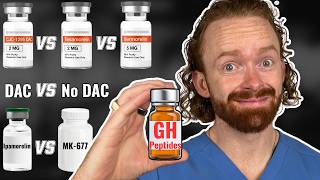 CJC-1295, Ipamorelin, Tesamorelin & Sermorelin: Deep Dive
Sources
- 1FDA prescribing information, EGRIFTA WR (tesamorelin) 11.6 mg vial, revised 3/2025Drug label
- 2FDA prescribing information, EGRIFTA SV (tesamorelin) 2 mg vial, on DailyMedDrug label
- 3Falutz et al., N Engl J Med 2007 (FDA trial 1, 412 adults with HIV, 26 weeks)Clinical trial
- 4Falutz et al., J Acquir Immune Defic Syndr 2010 (FDA trial 2, 404 adults with HIV, 12 months)Clinical trial
- 5Falutz et al., AIDS 2005 (1 mg vs 2 mg dose-finding trial, 12 weeks)Clinical trial
- 6Stanley et al., JAMA 2014 (belly fat and liver fat trial, 6 months)Clinical trial
- 7Stanley et al., Lancet HIV 2019 (fatty liver trial, 12 months)Clinical trial
- 8Makimura et al., J Clin Endocrinol Metab 2012 (adults with belly obesity and low growth hormone, 12 months)Clinical trial
- 9Baker et al., Arch Neurol 2012 (thinking skills in older adults, 1 mg at bedtime, 20 weeks)Clinical trial
- 10Stanley et al., J Clin Endocrinol Metab 2011 (growth-hormone pulses in healthy men, 2 weeks)Study
- 11Sinha et al., Transl Androl Urol 2020 (growth-hormone secretagogue review; GHRH plus GHRP-2)Review
- 12Jastreboff et al., N Engl J Med 2023 (retatrutide phase 2 obesity trial)Clinical trial
- 13German Sport University Cologne: WADA 2026 Prohibited List, class S2 (names tesamorelin; banned at all times)Reference
- 14Peptide Protocol Wiki: Tesamorelin community protocols (100 reports)Community
Where people discuss it
The FDA and Big PharmaWhat “not FDA-approved” really means
Some peptides, like semaglutide (Ozempic and Wegovy), are FDA-approved medicines. Most of the peptides people research are not. That label sounds like the FDA tested something and turned it down. Usually it means something else: nobody has paid for the studies the FDA needs to see. Here is why.
The FDA doesn’t test drugs. Companies do.
The FDA does not run its own drug tests. A company that wants to sell a new medicine has to test it first, and pay for it. It studies the drug in animals, then in people: first 20 to 100 volunteers, then a few hundred, then up to 3,000. Then it sends all the results to the FDA. FDA scientists review them and decide whether the benefits outweigh the risks.
So approval always starts with a company asking for it. If no company applies, the FDA has nothing to review, however promising the research looks.
Those studies cost about a billion dollars
A study in the medical journal JAMA estimated that bringing one new drug to market costs a typical company about $1.1 billion. That figure includes the money spent on drug ideas that failed along the way, because many drugs that start human testing never make it.
A patent is how a company earns that money back
A patent is a right the government gives an inventor. For up to 20 years from the day the inventor applies, nobody else may make or sell the invention without permission.
For a drug company, that right is what makes the billion-dollar bet worth it. While the patent lasts, the company is the only seller, so it can charge enough to pay back the studies and the failures. When the patent runs out, other companies can sell cheap copies, called generics, and the price drops.
The FDA adds a shorter shield of its own. For 5 years after a brand-new drug is approved, no copycat version can apply for approval. That helps, but it is much shorter than a patent can last.
Why most peptides can’t be patented
To get a patent, an invention has to be new, and it has to be something people made, not something found in nature. Most popular peptides fail one test or both.
They come from nature. Many are copies or small pieces of molecules your body already makes. KPV is a 3-building-block piece of the hormone that tans your skin. BPC-157 is copied from a protein in stomach juice. In 2013 the US Supreme Court ruled that something that exists in nature, like a human gene, cannot be patented just because someone found it and pulled it out.
They aren’t new anymore. Many were first described in research papers decades ago. Scientists were already testing KPV in the 1980s. Once something has been published, it no longer counts as new, so nobody can patent it now, and any patents from back then have long since run out.
Without a patent, a company that paid for the studies would soon face rivals selling the same peptide without having paid for any research. Few companies will spend a billion dollars on a product anyone can copy. So nobody goes first, and the large human studies never happen.
The workaround: change the molecule
Drug companies do make peptide medicines, but they change the peptide first. A changed molecule is a new invention, so it can be patented. Semaglutide is a lab-made version of GLP-1, a gut hormone your body releases after meals, changed so one shot lasts a week. Tesamorelin (Egrifta) is the body’s own growth-hormone signal with a small fatty chain added. Both went through the full studies, and both are FDA-approved.
The natural versions, and the many peptides nobody has changed and patented, stay where they are: studied in labs and animals, used by the biohacking community, and never put through large human trials.
What this means for you
When a peptide is “not FDA-approved,” it usually means no company has paid for the large human studies. It does not mean the FDA tested it and found it harmful.
It also does not mean it is proven safe or proven to work. Without those studies, nobody knows the best dose for sure, or what rare or long-term side effects it may have. And the FDA does not check research peptides for purity or strength the way it checks approved medicines. That is why this page labels every finding by the kind of study behind it, and lists who should not use it.
Sources for this section
- 1FDA: How drugs are developed and approved (the FDA does not test drugs; companies submit the evidence)
- 2FDA: The drug development process, step 3: clinical research (study sizes for each phase)
- 3Wouters, McKee & Luyten, JAMA 2020, corrected 2022: median cost to bring a new drug to market, $1.14 billion
- 4US patent law, 35 U.S.C. § 154: a patent lasts 20 years from the filing date
- 5FDA: Frequently asked questions on patents and exclusivity (5-year new chemical entity exclusivity)
- 6US Supreme Court, Association for Molecular Pathology v. Myriad Genetics (2013): naturally occurring genes cannot be patented